How to Pay Rent Monthly in Saudi Arabia in 2026
How to pay rent monthly in Saudi Arabia in 2026. The model explained, how it differs from a bank loan, and the steps to take if you have already picked a unit.
How to Pay Rent Monthly in Saudi Arabia in 2026
If you are looking for a way to pay your apartment rent monthly in Saudi Arabia instead of paying a full year upfront, you are facing a market reality that most tenants know well: the Saudi rental market has run on the annual-upfront model for decades, and landlords are generally not enthusiastic about switching to a monthly arrangement because of the collection risks that come with it. But that does not mean the monthly option is closed. Over the last few years, a clear financial mechanism has emerged that lets the tenant pay monthly while the landlord still receives exactly what they expect.
This guide walks through how the monthly-rent model in Saudi Arabia actually works in 2026, how it compares to the other options, and the practical steps if you already have an apartment in mind.
Why annual upfront is still the default
The reason is custom, not law. In Riyadh, Jeddah, and Dammam, landlords are used to receiving the full year in a single transfer or via one or two post-dated cheques, and they rely on that cash flow for mortgage installments or further property investment. Traditionally, landlords collect the year upfront via post-dated cheques, and the model assumes the tenant can come up with the full amount at once.
For an average tenant, that means coming up with roughly SAR 24,000 to SAR 120,000 before the lease is signed, depending on unit type and city. The gap between a monthly salary and that lump-sum requirement is the largest friction point in the Saudi rental experience today, especially for younger workers and first-time renters.
How monthly rent actually works
The core idea is simple: you cannot ask the landlord to convert your annual payment into monthly installments, but you can put a third party into the transaction. That third party pays the landlord the full year upfront, and you then pay the third party monthly with a clearly disclosed service fee. The landlord gets exactly what they want, and you convert one large cash event into a manageable monthly line item.
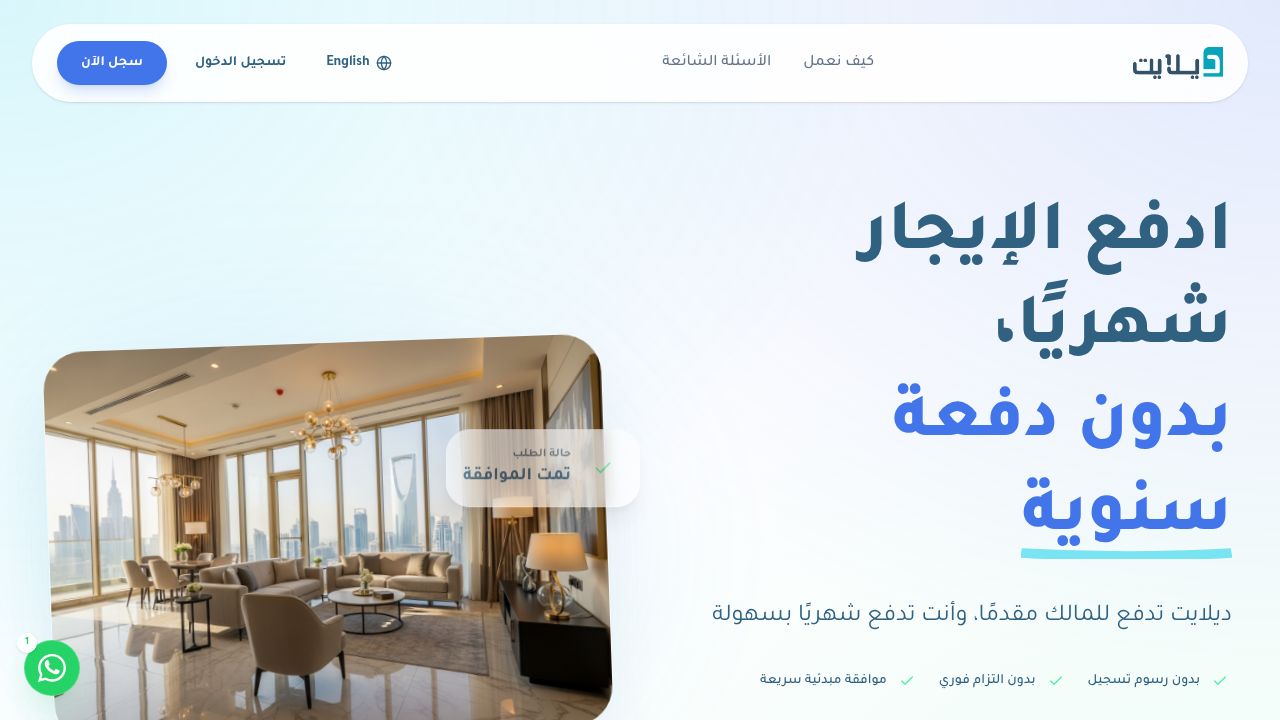
Dlight, a Saudi fintech company, runs exactly this model. After your application is approved and the lease is signed, Dlight pays the landlord the annual rent on your behalf, and you start paying Dlight monthly with a service fee that is fully disclosed before you commit.
One important note: you bring the apartment. Dlight does not list apartments, does not find apartments for tenants, and does not match tenants to units. You pick the unit — directly with the landlord or through a broker — and Dlight comes in afterward to handle the payment conversion.
How is this different from a personal loan?
- Personal loan from a bank. A financing product with an annual profit rate. It registers as a long-term loan obligation and consumes part of your future borrowing capacity.
- Monthly rent through Dlight. Not a loan and not a personal-financing product. The model is based on a service fee, not interest, and is compatible with Islamic finance principles. It is tied directly to the lease, not to a standalone financial product.
In practice, the arrangement is not structured as a long-term personal-loan obligation with a bank — a structural difference if you plan to apply for a mortgage or car finance later and want to weigh each obligation on its own terms.
The actual steps
- Pick the apartment. Direct with the landlord or via a broker.
- Apply through dlight.ai/register. Takes a few minutes.
- Eligibility review. Applications are reviewed and approval is not guaranteed.
- Sign the lease through Ejar. The lease stays between you and the landlord and is officially registered through Ejar, the Saudi government rental-contract platform.
- Monthly payments begin. Dlight pays the landlord the annual rent, and you start paying Dlight on the agreed monthly schedule.
For Riyadh-specific examples, see the Riyadh monthly-rent guide. If the guarantor question is relevant, the no-guarantor rental guide covers what tenants typically ask.
What to prepare
- Valid national ID or residency.
- Verifiable income.
- The apartment details and the landlord or broker's contact.
No guarantor is required. The lease is registered between you and the landlord on Ejar; your monthly payments to Dlight are a separate financial arrangement.
FAQ
Does the landlord need to approve the monthly arrangement?
The landlord receives the full year upfront, the same as a traditional lease — so from their side, nothing changes. The lease is registered through Ejar in the standard way, and you separately pay Dlight monthly afterward.
Is this Shariah-compatible?
The model is based on a service fee, not interest, and is compatible with Islamic finance principles. Fees are disclosed before you complete the application and there are no hidden charges.
How long does review take?
Review time depends on the completeness of submitted information; no specific approval window is guaranteed.
Next step
If you have already picked the apartment and want to switch to a monthly schedule instead of paying a full year upfront, convert your annual rent into monthly payments with Dlight. Apply through dlight.ai/register — it takes a few minutes.